
.jpeg)
What are the functions and effects of ensidipine?
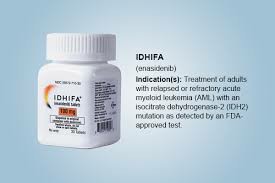
Enasidenib is an oral targeted inhibitor mainly used to treat a specific type of leukemia, namely newly diagnosed, refractory or relapsed acute myeloid leukemia (AML). It acts as an IDH2 (isocitrate dehydrogenase 2) inhibitor in AML patients with IDH2 mutations. To understand the efficacy and role of ensidipine, we need to conduct in-depth discussions on the mechanism of action of the IDH2 enzyme it targets, the clinical effect of treatment, and the impact on the biological properties of AML cells.
1. IDH2inhibition
IDH2 is an enzyme that plays an important role in cells and is involved in regulating cell metabolism and signal transduction. In some AML patients, there are IDH2 gene mutations, leading to an increase in the abnormal activity of IDH2 enzyme. This mutation causes cells to overproduce 2-hydroxyvaleric acid (2-HG), which inhibits cell differentiation and proliferation and promotes the development of AML. As an IDH2 inhibitor, ensidipine can specifically inhibit the activity of IDH2 enzyme and reduce the level of 2-HG, thereby restoring normal cell differentiation and proliferation.
2. Therapeutic effect onAML
Clinical trials have shown that ensidipine exhibits significant anti-tumor activity in the treatment of IDH2 mutated AML patients. Studies have shown that ensidipine can effectively inhibit the proliferation and survival of AML cells, leading to AMLCell differentiation and apoptosis. At the same time, ensidipine can also reduce the level of 2-HG in AML cells, restore normal cell metabolism and signaling, thereby blocking the development of AML.
3. Clinical efficacy
Ensidipine has demonstrated significant clinical efficacy in clinical trials. Studies have shown that in some patients with IDH2-mutated AML, long-lasting clinical responses, including complete or partial responses, occurred after treatment with ensidipine. In addition, ensidipine also prolonged the progression-free survival (PFS) and overall survival (OS) of patients, and improved the prognosis and quality of life of patients.
4. Influence of biological characteristics
In addition to directly inhibiting the proliferation and survival of AML cells, ensidipine also affects the biological properties of AML cells. Studies have shown that ensidipine can induce the differentiation of AML cells and promote their differentiation into mature myeloid cells, thus enhancing the sensitivity of cells to chemotherapy and immunotherapy. In addition, ensidipine can also improve the immune microenvironment of AML patients, reduce immune escape and immunosuppression, and enhance the effect of immunotherapy.
In summary, ensidipine, as an IDH2 inhibitor, inhibits the proliferation and survival of AML cells and restores normal cell differentiation and proliferation, thereby playing an anti-leukemia role. It can improve the prognosis and quality of life of AML patients and provide new treatment options for the treatment of AML. However, the specific efficacy and safety of ensidipine need to be further verified in more clinical studies.
[ 免责声明 ] 本页面内容来自公开渠道(如FDA官网、Drugs官网、原研药厂官网等),仅供持有医疗专业资质的人员用于医学药学研究参考,不构成任何治疗建议或药品推荐。所涉药品可能未在中国大陆获批上市,不适用于中国境内销售和使用。如需治疗,请咨询正规医疗机构。本站不提供药品销售或代购服务。


