
.jpeg)
What does dacomitinib/dacomitinib tablets treat?
Dacomitinib/Dacomitinib (Dacomitinib) has been approved since its approval for the treatment of locally advanced or metastatic non-small cell lung cancer. The drug can be used in adults with cancer cells that have specific mutations that cause tumors to grow faster. Some patients with non-small cell lung cancer have an abnormal protein called epidermal growth factor receptor (EGFR) in their tumor tissue. Mutated receptors may lead to uncontrolled tumor growth. There are many different mutations, such as L858R or del19. Dacomitinib is designed to block the mutated receptor in these patients, thereby preventing further tumor growth.
Preclinical data indicate that dacomitinib increases inhibition of the epidermal growth factor receptor kinase domain and activity in cell lines containing resistance mutations such asT790M. This activity further significantly reduced EGFR phosphorylation and cell viability. In these studies, a non-small cell lymphoma cancer cell line harboring the L858R/T790M mutation was used, and the observed IC50 was approximately 280 nmol/L.
In clinical trials of patients with advanced non-small cell lung cancer who progressed after chemotherapy, the objective response rate was 5%, progression-free survival was 2.8 months, and overall survival was 9.5 months. Additionally, a phase I/II study showed positive activity with dacomitinib despite previous failures with tyrosine kinase inhibitors
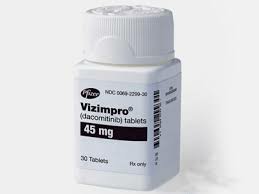
Dacotinib is available on the market in tablet form, and the originator drug is available in three different dosages: 15, 30 and 45 mg. The recommended dose is 45 mg once daily, taken at the same time each day. If side effects occur, the dose can be adjusted. Stop treatment if very serious side effects occur or the cancer progresses.
[ 免责声明 ] 本页面内容来自公开渠道(如FDA官网、Drugs官网、原研药厂官网等),仅供持有医疗专业资质的人员用于医学药学研究参考,不构成任何治疗建议或药品推荐。所涉药品可能未在中国大陆获批上市,不适用于中国境内销售和使用。如需治疗,请咨询正规医疗机构。本站不提供药品销售或代购服务。


