
.jpeg)
Brigatinib/Brigatinib Instructions
1. Generic name: Brigatinib, Brigatinib
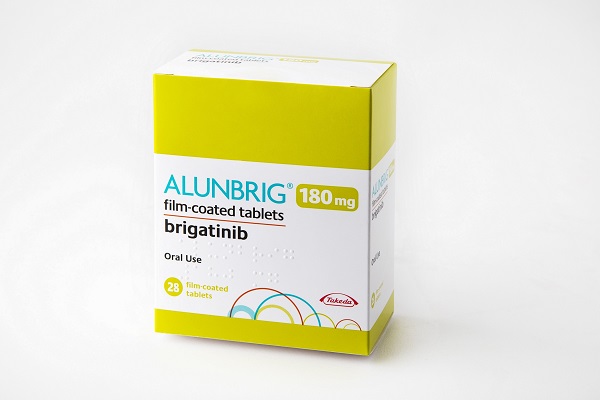
Product name:Alunbrig, Amberry
Other names: brigatinib, brigitabine, brigatinib, brigitabine, oncinnengbi
2. Indications:
Brigatinib Brigatinib is indicated for the treatment of adult patients with anaplastic lymphoma kinase (ALK)-positive metastatic non-small cell lung cancer (NSCLC) as determined by a U.S. Food and Drug Administration (FDA)-approved test.
3. Usage and dosage:
1. Before treatment: Based on the presence of ALK positivity in tumor specimens, doctors will choose to use brigatinib to treat patients with metastatic non-small cell lung cancer.
2. Recommended dose: The recommended dose of brigatinib is: 90 mg orally once a day for the first 7 days, then increase the dose to 180 mg orally once a day, and administer until disease progression or unacceptable toxicity. Brigatinib can be taken with or without food. Patients should swallow the tablet whole and do not crush or chew the tablet. If you miss a dose of brigatinib or develop vomiting after taking a dose, do not take another dose and take the next dose at the scheduled time.
3. Dose adjustment: If the patient experiences adverse reactions while taking brigatinib, the doctor may adjust the drug dose. When the dose is 90 mg, the first dose can be adjusted to 60 mg once a day. Patients who cannot tolerate it will stop using it; when the dose is 180 mg, the first dose can be adjusted to 120 mg once a day, the second dose can be adjusted to 90 mg once a day, and the third dose can be adjusted to 60 mg once a day. Once the dose is reduced due to adverse effects, do not subsequently increase the brigatinib dose. If a patient is taking brigatinib for 14 days or more without interruption due to adverse effects, continue treatment at a dose of 90 mg once daily for 7 days before increasing to the previously tolerated dose.
4. Dose adjustment for drug interactions
(1)Strong or moderateCYP3A inhibitors: Avoid concomitant use of strong or moderateCYP3A inhibitors during treatment with brigatinib. If this cannot be avoided, the dose should be reduced by approximately 50% (i.e., from 180 mg to 90 mg, or from 90 mg to 60 mg). After discontinuing a strong or moderate CYP3A inhibitor, resume the dose as tolerated before initiating the CYP3A inhibitor.
(2)ModerateCYP3A inducers: Avoid concomitant use of moderateCYP3A inducers during treatment with brigatinib. If this cannot be avoided, after 7 days of treatment with the currently tolerated dose, increase the once-daily dose in 30 mg increments up to twice the dose tolerated before initiating the moderate CYP3A inducer. After discontinuing a moderate CYP3A inducer, resume the dose tolerated before initiating the moderate CYP3A inducer.
5. Dose adjustment for special patients: For severe hepatic impairment (Child-Pugh C) For patients with severe renal impairment [creatinine clearance (CLcr) measured by Cockcroft-Gault is 15-29 mL/min], the once-daily dose of brigatinib should be reduced by approximately 40% (i.e., from 180 mg to 90 mg, or from 90 mg to 60 mg).
4. Adverse reactions:
In clinical studies of brigatinib, the most common adverse reactions included hyperglycemia (high blood sugar levels), hyperinsulinemia (high blood insulin levels), anemia (low red blood cell count), nausea, low white blood cell count (including low levels of white blood cells called lymphocytes), diarrhea, fatigue, cough, headache, hypophosphatemia (blood (low phosphate levels in fluid), rash, vomiting, difficulty breathing, high blood pressure, and blood test results indicating abnormalities in the liver (Elevated levels of ALT and AST and alkaline phosphatase), pancreas (elevated lipase and amylase), muscle function (elevated CPK), or blood coagulation (elevated APTT).
5. Storage:
Brigatinib is available as an oral tablet and may be stored at controlled room temperature between 20°C and 25°C (68°F to 77°F); excursions allowed between 15°C and 30°C (59°F to 86°F).
6. Special groups:
1. Women: Brigatinib may cause fetal harm; it is recommended that women of childbearing potential use effective contraceptive measures during drug treatment and for at least 4 months after the last dose; lactating women should not breastfeed during treatment and for 1 week after the last dose.
2. Men: Based on findings in the male reproductive organs of animals, brigatinib may cause a decrease in male fertility. Due to the potential for genotoxicity, advise men with female partners of potential reproductive potential to use effective contraception during treatment and for at least3 months after the last dose.
7. Mechanism of action:
Brigatinib is a tyrosine kinase inhibitor (TKI), with in vitro activity against multiple kinases at clinically achievable concentrations, including ALK, ROS1, insulin-like growth factor-1 receptor (IGF-1R), FLT-3, and EGFR deletions and point mutations. In in vitro and in vivo experiments, brigatinib inhibited ALK autophosphorylation and ALK-mediated phosphorylation of downstream signaling proteins STAT3, AKT, ERK1/2 and S6. Brigatinib also inhibited in vitro proliferation of cell lines expressing EML4-ALK and NPM-ALK fusion proteins and demonstrated dose-dependent inhibition of EML4-ALK-positive non-small cell lung cancer xenograft growth in mice.
At clinically achievable concentrations (≤500nM), brigatinib inhibited the expression of EML4-ALK and 17 species related to A In vitro viability of cells with mutant forms associated with resistance to LK inhibitors, including crizotinib, EGFR-Del (E746-A750), ROS1-L2026M, FLT3-F691L, and FLT3-D835Y. Brigatinib has in vivo anti-tumor activity against four EML4-ALK mutant forms, including the G1202R and L1196M mutations found in patients with non-small cell lung cancer tumors treated with crizotinib. Brigatinib also reduced tumor burden and prolonged survival in mice intracranially implanted with ALK-driven tumor cell lines.
[ 免责声明 ] 本页面内容来自公开渠道(如FDA官网、Drugs官网、原研药厂官网等),仅供持有医疗专业资质的人员用于医学药学研究参考,不构成任何治疗建议或药品推荐。所涉药品可能未在中国大陆获批上市,不适用于中国境内销售和使用。如需治疗,请咨询正规医疗机构。本站不提供药品销售或代购服务。


