
.jpeg)
Imdelltra (Tarlatamab-dlle) Efficacy
The U.S. Food and Drug Administration (FDA)has approvedImdelltra (Tarlatamab-dlle) for the treatment of patients with extensive small cell lung cancer (ES-SCLC) whose disease has progressed on or after platinum-based chemotherapy. Efficacy was evaluated in the open-label, multicenter, multi-cohort, phase 2 DeLLphi-301 trial (NCT05060016), which included 99 patients with relapsed/refractory ES-SCLC whose disease had progressed after platinum-based chemotherapy.
The primary and secondary efficacy endpoints were objective response rate (ORR) and median duration of response (DOR), respectively, based on RECIST 1.1 criteria as assessed by investigators and blinded independent central reviewers. Trial results showed that Imdelltra's objective response rate (ORR) was 40% (95% CI, 31%-51%), and the median duration of response (DOR) was 9.7 months (range, 2.7-20.7+). Among 69 patients with evaluable platinum sensitivity status, 27 patients with platinum-resistant SCLC, defined as progression within 90 days of the last dose of platinum therapy, had an ORR of 52% (95% CI, 32%-71%), and 42 patients with platinum-sensitive SCLC had an ORR of 31% (95% CI, 18%-47%), defined as progression at least 90 days after the last dose of platinum therapy.
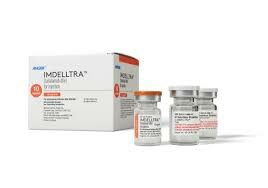
In addition, disease control, progression-free survival (PFS), overall survival (OS), safety and serum concentration levels of Imdelltra were evaluated. Trial results showed that in patients with advanced small cell lung cancer and disease progression after platinum-based chemotherapy, the median PFS of Imdelltra was 4.9 months (95% CI, 2.9-6.7) in the 10 mg cohort and 3.9 months (95% CI, 2.6-4.4) in the 100 mg cohort. Although the median OS has not yet matured, with more than 50% of patients in both cohorts still alive at the time of last follow-up, the median OS in the 10 mg and 100 mg cohorts was 14.3 months (95% CI, 10.8-not evaluable [NE]) and NE (95% CI, 12.4-NE), respectively. The median follow-up time was 10.6 months in the 10 mg group and 10.3 months in the 100 g group.
Other results are shown inIn the 10 mg group (n=100), the ORR was 40% (97.5% CI, 29%-52%), and the disease control rate (DCR) was 70% (95% CI, 60%-79%). In the 100 mg group (n=88), the ORR was 32% (97.5% CI, 21%-44%) and the DCR was 63% (95% CI, 52%-73%). Of note, the responses recorded were independent of DLL3 expression or tumor tissue availability. The median time to response was 1.4 months (range 1.1-9.6), and the median DOR was not reached. Of the 68 responders, 59% (n=40) had responses lasting 6 months or longer.
[ 免责声明 ] 本页面内容来自公开渠道(如FDA官网、Drugs官网、原研药厂官网等),仅供持有医疗专业资质的人员用于医学药学研究参考,不构成任何治疗建议或药品推荐。所涉药品可能未在中国大陆获批上市,不适用于中国境内销售和使用。如需治疗,请咨询正规医疗机构。本站不提供药品销售或代购服务。


