
.jpeg)
Overview of the package insert for larotinib/larlotinib
1. Common name: larotrectinib, Larotrectinib
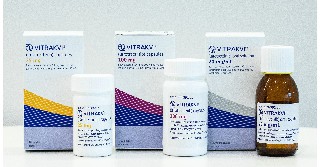
Product name: VITRAKVI, VITRAKVI
All names: larotinib, larotinib sulfate capsules, larotinib sulfate oral solution
2. Indications:
Larotrectinib is indicated for the treatment of adult and pediatric patients with solid tumors who may have neurotrophic receptor tyrosine kinase (NTRK) gene fusions without known acquired resistance mutations, or who may have metastasis or surgical resection that would result in significant morbidity and who have no satisfactory alternative therapies or who have progressed after treatment.
3. Usage and dosage:
1. Before treatment: Select patients to receive larotrectinib treatment based on the presence of NTRK gene fusion in tumor specimens. There are currently no FDA-approved methods for detecting NTRK gene fusions.
2. Recommended dose: The recommended dose of larotrectinib is based on the patient's body surface area; for adult and pediatric patients with a body surface area of at least (≥) 1.0 m², the dosage is 100 mg orally twice daily; for adult and pediatric patients with a body surface area less than (<) 1.0 m², the dosage is 00 mg/m² orally twice daily, with or without food, until disease progression or until unacceptable toxicity.
3. Dosage adjustment: If the patient experiences adverse reactions when using larotrectinib, the doctor may adjust the drug dose according to the severity of the condition. For example, the patient's first dose can be adjusted to oral twice a day75mg (or 75mg/m2); the second dose can be adjusted to oral twice a day span>50mg (or 50mg/m2); the third dose can be adjusted to taken once daily100mg (or 25mg/m2 twice daily);Patients who cannot tolerate it after three dose adjustments should permanently discontinue larotrectinib. If adverse reactions do not resolve within 4 weeks, permanently discontinue larotrectinib.
(1)StrongCYP3A4 inhibitors: Avoid coadministration of strongCYP3A4 inhibitors with larotrectinib. If this cannot be avoided, the dose of larotrectinib should be reduced by 50%. After discontinuing the inhibitor 3 to 5 elimination half-lives, resume the previous dose of the CYP3A4 inhibitor.
(2)StrongCYP3A4 inducers: Avoid coadministration of strongCYP3A4 inducers with larotrectinib. If this cannot be avoided, double the dose of larotrectinib. On inducer discontinuationAfter 3 to 5 elimination half-lives, resume the dose you took before starting the CYP3A4 inducer.
(3) Patients with hepatic impairment: Start dose reduction of larotrectinib by 50% in patients with moderate (Child-Pugh Class B) to severe (Child-Pugh Class C) hepatic impairment.
4. Medication management: Larotrectinib capsules or oral solution can be used interchangeably; swallow the entire capsule with water. Do not chew or crush capsules; store glass bottles of larotrectinib oral solution in the refrigerator. Do not take a missed dose within 6 hours of your next scheduled dose. If you experience vomiting after taking one dose of larotrectinib, take the next dose at the scheduled time.
4. Adverse reactions:
In clinical studies of larotrectinib, the most common adverse reactions (≥20%) were fatigue, nausea, dizziness, vomiting, anemia, aspartate aminotransferase (A ST) elevation, cough, alanine aminotransferase (ALT) elevation, constipation, and diarrhea; the most common serious adverse reactions (≥2%) were pyrexia, diarrhea, sepsis, abdominal pain, dehydration, cellulitis, and vomiting.
5. Supply and storage:
Larotinib is available in capsules (25mg, 100mg) and oral solution (20mg/mL). Capsule formulations may be stored at room temperature 20°C to 25°C (68°F to 77°F); allow temperature fluctuations between 15°C to 30°C (59°F to 86°F). Oral solution formulations may be refrigerated at 2°C to 8°C (36°F to 46°F); do not freeze; discard any unused larotrectinib oral solution 90 days after first opening.
6. Special groups:
1. Women: Based on literature reports on human subjects with congenital mutations that lead to altered TRK signaling, animal study results, and its mechanism of action, larotrectinib taken by pregnant women can cause embryo-fetal damage. Therefore, it is recommended that female patients of reproductive potential use effective contraception during treatment and for at least 1 week after the last dose; women should not breastfeed during treatment and for 1 week after the last dose.
2. Men: Larotrectinib may reduce fertility, so men who are female partners of reproductive potential are advised to use effective contraception during treatment with larotrectinib and within 1 week after the last dose.
7. Mechanism of action:
Larotinib is a tropomyosin receptor kinase (TRK), TRKA, TRKB and TRKC inhibitors. In a series of purified enzyme assays, larotrectinib inhibits TRKA, TRKB, and TRKC with IC50 values u200bu200branging from 5-11 nM. Another kinase, TNK2, was inhibited at approximately 100-fold higher concentrations. TRKA, B and C are encoded by the genes NTRK1, NTRK2, and NTRK3. Chromosomal rearrangements involving in-frame fusion of these genes with different partners produce constitutively activated chimeric TRK fusion proteins that act as oncogenic drivers to promote cell proliferation and survival in tumor cell lines.
In in vitro and in vivo tumor models, larotrectinib showed anti-tumor activity in cells with constitutively activated TRK protein resulting from gene fusion, deletion of the protein regulatory domain, or in cells with overexpression of TRK protein. Larotrectinib is least active in cell lines with point mutations in the TRKA kinase domain, including the clinically identified acquired resistance mutation G595R. Point mutations in the TRKC kinase domain have been associated with clinically established acquired resistance to larotrectinib, including G623R, G696A, and F617L.
[ 免责声明 ] 本页面内容来自公开渠道(如FDA官网、Drugs官网、原研药厂官网等),仅供持有医疗专业资质的人员用于医学药学研究参考,不构成任何治疗建议或药品推荐。所涉药品可能未在中国大陆获批上市,不适用于中国境内销售和使用。如需治疗,请咨询正规医疗机构。本站不提供药品销售或代购服务。


