
.jpeg)
Overview of the Chinese package inserts for pazopanib/pazopanib
1. Name: Pazopanib, Pazopanib
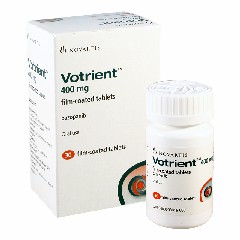
Product name: Votrient、Votrient
Other names: pazopanib
2. Indications:
1. Renal cell carcinoma (RCC) : Pazopanib/Pazopanib (Pazopanib) is suitable for the treatment of advanced renal cell carcinoma in adults;
2. Soft tissue sarcoma (STS): Pazopanib is indicated for the treatment of adults with advanced soft tissue sarcoma who have previously received chemotherapy.
Limitations of use: Adults Treatment of adipocytesSTS or gastrointestinal stromal tumors (GIST) has not been proven.
3. Usage and dosage:
1. Recommended dose: The recommended dose of pazopanib is 800 mg (four 200 mg tablets), taken orally once a day without food (at least 1 hour before or 2 hours after a meal) until disease progression or unacceptable toxicity occurs. Pazopanib tablets should be swallowed whole. Do not crush tablets as absorption may be increased, which may affect systemic exposure. If a dose is missed, it should not be taken if it is less than 12 hours before the next dose.
2. Dose adjustment: For patients with liver damage and taking certain concomitant drugs, the dose should be modified. For patients with RCC, the first dose may be reduced to 400 mg orally once daily; the second dose may be reduced to 200 mg; for patients with STS, the first dose may be reduced to 600 mg orally once daily; the second dose may be reduced to 400 mg; patients who cannot tolerate the second dose reduction should permanently discontinue pazopanib.
(1) Hepatic Impairment:For patients with moderate hepatic impairment [total bilirubin >1.5 to 3 times the upper limit of normal (ULN) and any alanine aminotransferase (ALT) value], consider alternatives to pazopanib. If pazopanib is used in patients with moderate hepatic impairment, reduce the dose to 200 mg orally once daily. Pazopanib is not recommended for patients with severe hepatic impairment (total bilirubin > 3 × ULN and any ALT value).
3. Drug interactions:
(1)StrongCYP3A4 inhibitors: Avoid concurrent use of strongCYP3A4 inhibitors and use alternative concomitant medications that have little or no potential to inhibit CYP3A4. If coadministration of a strong CYP3A4 inhibitor is necessary, reduce the pazopanib dose to 400 mg.
(2)PotentCYP3A4 inducers: Avoid concurrent use of strongCYP3A4 inducers and use alternative concomitant medications that have no or minimal enzyme induction potential. Pazopanib is not recommended for patients taking long-term use of strong CYP3A4 inducers.
(3)Gastric acid reducers: Avoid concurrent use of gastric acid reducers. If this cannot be avoided, consider using short-acting antacids instead of proton pump inhibitors (PPIs) and H2 receptor antagonists. Separate administration of short-acting antacids and pazopanib by several hours.
4. Adverse reactions:
In clinical studies of pazopanib, the most common adverse reactions (≥20%) in RCC patients were diarrhea, hypertension, hair color change, nausea, fatigue, anorexia and vomiting; STS the most common adverse reactions in patients Common adverse reactions (≥20%) are fatigue, diarrhea, nausea, weight loss, hypertension, decreased appetite, vomiting, tumor pain, hair color change, musculoskeletal pain, headache, dysgeusia, dyspnea and skin hypopigmentation
After pazopanib was put on the market, adverse events such as polycythemia, retinal detachment/tear, pancreatitis, tumor lysis syndrome (including fatal cases), arterial (including aorta) aneurysm, dissection and rupture (including fatal cases) have also occurred.
5. Storage:
Pazopanib tablets should be stored at 20°C to 25°C (68°F to 77°F), with an allowed excursion between 15°C and 30°C (59°F to 86°F).
6. Mechanism of action:
Pazopanibis a vascular endothelial growth factor receptor (VEGFR)-1, VEGFR-2, VEGFR-3, platelet-derived growth factor receptor-alpha and -beta, fibroblast growth factor receptor-1 and -3. Multi-tyrosine kinase inhibitors of cytokine receptor (Kit), interleukin-2 receptor-induced T cell kinase (Itk), lymphocyte-specific protein tyrosine kinase (Lck) and transmembrane glycoprotein receptor tyrosine kinase (c-Fms). In vitro, pazopanib inhibits ligand-induced autophosphorylation of VEGFR-2, Kit and PDGFR-β receptors. In vivo, pazopanib inhibitsVEGF-induced VEGFR-2 phosphorylation in mouse lungs, angiogenesis in mouse models, and growth of some human tumor xenografts in mice.
7. Overdose:
Dose-limiting toxicity (Grade 3 fatigue) and grade 3 hypertension were observed in 1 patient each at 2000 mg daily (2.5 times the recommended dose) and 1000 mg daily (1.25 times the recommended dose). Provide general supportive measures to control overdose. Hemodialysis is not expected to enhance the clearance of pazopanib because pazopanib is not significantly excreted by the kidneys and is highly bound to plasma proteins.
[ 免责声明 ] 本页面内容来自公开渠道(如FDA官网、Drugs官网、原研药厂官网等),仅供持有医疗专业资质的人员用于医学药学研究参考,不构成任何治疗建议或药品推荐。所涉药品可能未在中国大陆获批上市,不适用于中国境内销售和使用。如需治疗,请咨询正规医疗机构。本站不提供药品销售或代购服务。


