
.jpeg)
How long does it take for the effects of Opicapone to appear?
Opicapone (Opicapone), an innovative long-acting reversible catecholamine-O-methyltransferase (COMT) inhibitor, has been approved as an adjuvant drug for patients with Parkinson's disease. It primarily targets fluctuations in motor function at the end of the levodopa dose. The mainstay of treatment for Parkinson's disease is the combination of levodopa and a peripheral dopa decarboxylase inhibitor, such as benserazide or carbidopa.
It is recommended that patients take Opicapone at least one hour before or after their evening dose of levodopa to ensure optimal results. It is important to note that food can affect its absorption. Although the elimination half-life of opicapone is only approximately 1-2 hours, a single 50 mg dose can inhibit COMT for more than 24 hours. Because it can significantly increase the concentration of levodopa, when adding opicapone to treatment, it is necessary to reduce the dose of levodopa accordingly or extend the interval between doses.
Concomitant use of opicapone with a monoamine oxidase inhibitor such as phenelzine is contraindicated, but it may be combined with another monoamine oxidase inhibitor indicated for Parkinson's disease, such as selegiline. No dose adjustment of Opicapone is needed in patients with kidney disease, but use should be avoided in patients with liver disease.
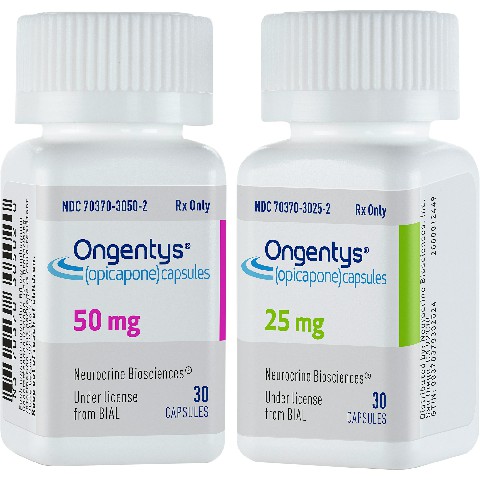
In a clinical trial involving427 patients with limited motor function at least some time each day, researchers compared opicapone as an adjunct to levodopa versus placebo. The study consisted of a 14-15-week double-blind phase, after which all patients received one year of open-label opicapone treatment. During the double-blind phase, patients received daily doses of 25 mg (129 patients) and 50 mg (154 patients) of opicapone. By the end of the double-blind phase, the two doses reduced motor function limitations by an average of 102 minutes and 119 minutes, respectively. Of note, only the 50 mg dose showed statistically significant improvement over placebo (65 minutes less), and this effect was maintained during the open-label phase.
Adding opicapone to levodopa therapy may increase the risk of dopaminergic side effects, such as dyskinesias, hallucinations, and orthostatic hypotension, requiring the levodopa dose to be adjusted accordingly. In both trials, dyskinesia was the most common adverse reaction, more common in the entacapone 50 mg group (16%) than in the entacapone 200 mg group (8%). In addition, Opicapone may cause other adverse effects such as nausea, constipation, and insomnia. In one of the trials, 12% of patients taking 50 mg of daily Opicapone discontinued treatment due to adverse events.
Results from clinical trials show that compared with placebo, daily administration of 50 mg of Opicapone can significantly reduce the time that patients have limited motor function and increase the time that patients can move freely. Although the time off medication was reduced by approximately 1 hour compared with placebo, at baseline, patients were off medication for an average of more than 6 hours. It's unclear to what extent Opicapone improves patients' quality of life. Its effect on disability was similar to placebo, and the trial did not include patients with more severe disabilities. The trial also excluded patients with psychiatric or cardiovascular disease. Although opicapone and entacapone appear to have similar efficacy, entacapone requires multiple doses throughout the day.
[ 免责声明 ] 本页面内容来自公开渠道(如FDA官网、Drugs官网、原研药厂官网等),仅供持有医疗专业资质的人员用于医学药学研究参考,不构成任何治疗建议或药品推荐。所涉药品可能未在中国大陆获批上市,不适用于中国境内销售和使用。如需治疗,请咨询正规医疗机构。本站不提供药品销售或代购服务。


