
.jpeg)
Instructions for Voranigo (Vorasidenib)
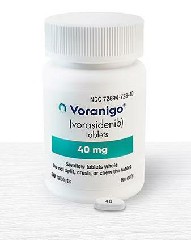
1. Name:Voranigo, Vorasidenib
2. Indications:
Voranigo (Vorasidenib) is indicated for the treatment of adult and pediatric patients aged 12 years and older with grade 2 astrocytoma or oligodendroglioma who are predisposed to isocitrate dehydrogenase-1 (IDH1) or isocitrate dehydrogenase-2 (IDH2) mutations after surgery, including biopsy, subtotal or total resection.
3. Usage and dosage:
1. Before treatment: Before starting to take Voranigo, evaluate blood chemistry and liver laboratory tests; select patients with grade 2 astrocytoma or oligodendroglioma for treatment based on the presence of IDH1 or IDH2 mutations in tumor specimens.
2. Recommended dose: For adult patients, the recommended dose of Voranigo is 40 mg orally once daily until disease progression or unacceptable toxicity occurs. The recommended dose for pediatric patients 12 years and older is based on body weight. Patients ≥40 kg can take 40 mg orally once daily; patients <40 kg can take 20 mg orally once daily. Treatment should be continued until disease progression or unacceptable toxicity occurs.
3. Medication management: Swallow Voranigo tablets whole with or without food Do not split, crush or chew tablets.
4. Dosage adjustment: Adverse reactions may occur when using Voranigo. The doctor may adjust the drug dose according to the severity of the condition. The first dose may be reduced to 20 mg orally once a day; the second dose may be reduced to 10 mg orally once a day; if the patient cannot tolerate the lowest dose of 10 mg once a day, Voranigo needs to be discontinued.
5. Missed dose: Take Voranigo tablets at approximately the same time each day. If you miss a dose, take the missed dose as soon as possible within 6 hours. If a dose is missed by more than 6 hours, skip the missed dose and take the next dose at the scheduled time. If vomiting occurs after taking one dose, do not take a replacement dose and take the next dose at the scheduled time the next day.
4. Adverse reactions:
In Voranigo’s clinical studies, the most common (≥15%) adverse reactions were fatigue, headache, COVID-19, musculoskeletal pain, diarrhea, nausea, and seizures; the most common (≥2%) grade 3 or 4 laboratory abnormalities were increased alanine aminotransferase (ALT), increased aspartate aminotransferase (AST), increased gamma-glutamyl transferase (GGT), and neutropenia.
5. Supply and storage:
Voranigo tablets are available in two strengths: 10 mg and 40 mg tablets, and can be stored at 20°C to 25°C (68°F to 77°F); excursions allowed between 15°C and 30°C (59°F to 86°F).
6. Special groups:
1. Women: According to animal embryo-fetal toxicity studies, pregnant women taking Voranigo will cause harm to the fetus. Because Voranigo can cause some hormonal contraceptives to be ineffective, advise women of reproductive potential to use effective non-hormonal contraceptives during treatment and for 3 months after the last dose; women should not breastfeed during treatment and for 2 months after the last dose.
2. Men: According to the results of animal studies, Voranigo may damage the fertility of male animals of reproductive potential; it is recommended that male patients with female partners of reproductive potential use effective contraceptive measures during treatment and within 3 months after the last dose.
7. Mechanism of action:
VoranigoActive IngredientsVorasidenib is a small molecule inhibitor of the isocitrate dehydrogenase-1 and 2 (IDH1 and IDH2) enzymes. In vitro, vorasidenib inhibits IDH1 wild-type and mutant variants, including R132H and IDH2 wild-type and mutant variants. In in vivo cell-based tumor models expressing IDH1 or IDH2 mutant proteins, vorasidenib reduced 2-hydroxyglutarate (2-HG) production and partially restored cell differentiation.
8. Pharmacodynamics:
Vorasidenib reduces 2-HG tumor concentrations in patients with IDH1 or IDH2 mutant gliomas. The percent reduction (95% CI) of 2-HG in tumors of patients who received vorasidenib at 0.3 to 0.8 times the highest recommended dose was 64% (22%, 88%) to 93% (76%, 98%) relative to tumors in the untreated group. The exposure-response relationship and the time course of pharmacodynamic response for the safety and efficacy of vorasidenib have not been fully established.
[ 免责声明 ] 本页面内容来自公开渠道(如FDA官网、Drugs官网、原研药厂官网等),仅供持有医疗专业资质的人员用于医学药学研究参考,不构成任何治疗建议或药品推荐。所涉药品可能未在中国大陆获批上市,不适用于中国境内销售和使用。如需治疗,请咨询正规医疗机构。本站不提供药品销售或代购服务。


