
.jpeg)
How effective is Voranigo (Vorasidenib)?
Voranigo (Vorasidenib) is the first systemic treatment approved by the U.S. Food and Drug Administration (FDA) for patients with grade 2 astrocytoma or oligodendroglioma who have predisposing IDH1 or IDH2 mutations. Clinical studies have shown that vorasidenib is well tolerated and its safety profile is consistent with the results of multiple studies.
InINDIGO (NCT04164901), a randomized, multicenter, double-blind, placebo-controlled trial, evaluated efficacy in 331 patients with grade 2 astrocytoma or oligodendroglioma who were susceptible to IDH1 or IDH2 mutations after surgery. Patients were randomized 1:1 to receive once-daily oral vorasidenib or once-daily oral placebo until disease progression or unacceptable toxicity. IDH1 or IDH2 mutation status was prospectively determined by Life Technologies Corporation on comine Dx Target Test. Patients randomized to placebo were allowed to crossover to vorasidenib after documented radiographic disease progression. Patients who had received previous anticancer treatment, including chemotherapy or radiotherapy, were excluded.
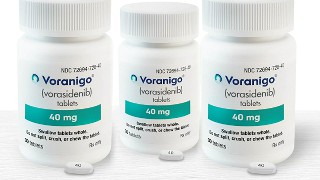
The primary efficacy outcome measure was progression-free survival (PFS) using modified response assessment based on the Neuro-Oncology Low-Grade Glioma (RANO-LGG) criteria by a blinded independent review committee. Another efficacy outcome measure was time to next intervention. The hazard ratio of PFS was 0.39 (95% CI: 0.27-0.56), with a p value of <0.0001. The median time to the next intervention was not reached in the vorasidenib group compared with 17.8 months in the placebo group (HR=0.26; 95% CI: 0.15-0.43, p<0.0001).
In the prespecified second interim analysis, the primary efficacy results of progression-free survival (PFS), based on key secondary endpoints of Blinded Independent Review Committee (BIRC) and time to next intervention (TTNI), were met in favor of the vorasidenib arm. Median PFS was 27.7 months in the vorasidenib group compared with 11.1 months in the placebo group (hazard ratio [HR], 0.39; 95% confidence interval [CI], 0.27-0.56; one-sided P<0.001). TTNI was also statistically significant (HR, 0.26; 95% CI, 0.15 to 0.43; one-sided P<0.001). The median TTNI was not reached with vorasidenib and 17.8 months with placebo. Vorasidenib also showed an average reduction in tumor volume of 2.5% (TGR, -2.5%; 95% CI: -4.7% to -0.2%), whereas tumor volume increased by an average of 13.9% (TGR, 13.9%; 95% CI: 11.1% to 16.8%), as measured by BIRC.
[ 免责声明 ] 本页面内容来自公开渠道(如FDA官网、Drugs官网、原研药厂官网等),仅供持有医疗专业资质的人员用于医学药学研究参考,不构成任何治疗建议或药品推荐。所涉药品可能未在中国大陆获批上市,不适用于中国境内销售和使用。如需治疗,请咨询正规医疗机构。本站不提供药品销售或代购服务。


