
.jpeg)
Instructions for Midostaurin
1. Common name:Midostaurin
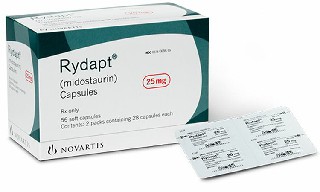
Product name:RYDAPT
Other names: Midostaurin, Midostaurin, Redpath (transliteration)
2. Indications:
1. Acute myeloid leukemia (AML): Midostaurin is indicated for use in combination with standard cytarabine and daunorubicin induction and cytarabine consolidation chemotherapy for the treatment of adult patients with newly diagnosed acute myeloid leukemia who are positive for FLT3 mutations as tested by an FDA-approved test.
Restrictions on use: Midostaurin is not suitable as single-agent induction therapy for the treatment ofAML patients.
2. Systemic mastocytosis (SM): Midostaurin is indicated for the treatment of adult patients with aggressive systemic mastocytosis (ASM), systemic mastocytosis with hematological tumors (SM-AHN), or mast cell leukemia (MCL).
3. Usage and dosage:
1. Patient selection: Select patients who receive midostaurin to treat AML based on the presence of FLT3 mutation positivity.
2. Recommended dosage: Monitor the patient's toxicity at least once a week for the first 4 weeks of treatment, every other week for the next 8 weeks, and then monthly during treatment.
(1) AML: For patients with AML, the recommended dose of midostaurin is 50 mg twice daily, taken orally with food on days 8-21 of each cycle for induction with cytarabine and daunorubicin and on days 8-21 of each cycle for high-dose cytarabine consolidation. Description of monotherapy experience with RYDAPT beyond induction and consolidation.
(2) ASM, SM-AHN and MCL: The recommended dose of midostaurin is 100 mg taken orally twice daily with food. Continue treatment until disease progression or unacceptable toxicity occurs.
3. Medication management: Before treatment with midostaurin, give preventive antiemetics to reduce the risk of nausea and vomiting. Midostaurin is taken by mouth with food twice daily, approximately 12 hours apart. Do not open or crush midostaurin capsules. If you miss or vomit a dose of midostaurin, do not take it; take the next dose at the usually scheduled time. If midostaurin is administered with drugs that prolong the QT interval, consider assessing the QT interval with an electrocardiogram (ECG).
4. Adverse reactions:
In clinical studies of midostaurin, inAML patients, the most common adverse drug reactions ((ADR)) were febrile neutropenia, nausea, mucositis, vomiting, headache, petechiae, musculoskeletal pain, epistaxis, device-related infection, Hyperglycemia, electrocardiogram QT interval prolongation, and upper respiratory tract infection. In patients with ASM, SM-AHN, and MC, the most common adverse reactions were nausea, vomiting, diarrhea, edema, musculoskeletal pain, abdominal pain, fatigue, upper respiratory tract infection, constipation, pyrexia, headache, and dyspnea.
5. Supply and storage:
Midostaurin is available as 25 mg soft gel capsules and should be stored at 20°C to 25°C (68°F to 77°F); tolerances are allowed between 15°C and 30°C (59°F and 86°F). Store in original container, protected from moisture.
6. Taboo:
Midostaurin is contraindicated in patients who are allergic to midostaurin or any excipients. Anaphylaxis includes anaphylactic shock, difficulty breathing, facial flushing, chest pain, and angioedema (such as swelling of the airways or tongue, with or without difficulty breathing).
7. Mechanism of action:
Midostaurin is a small molecule that inhibits multiple receptor tyrosine kinases. In vitro biochemical or cellular assays have shown that midostaurin or its major human active metabolites CGP62221 and CGP52421 inhibit the activity of wild-type FLT3, FLT3 mutant kinases (ITD and TKD), KIT (wild-type and D816V mutation), PDGFRα/β, and serine/threonine kinase PKC (protein kinase C) family members.
Midostaurin demonstrates the ability to inhibitFLT3 receptor signaling and cell proliferation, and it induces apoptosis in leukemia cells expressing ITD and TKD mutant FLT3 receptors or overexpressing wild-type FLT3 and PDGF receptors. Midostaurin has also demonstrated the ability to inhibit KIT signaling, cell proliferation and histamine release, as well as induce mast cell apoptosis.
8. Special groups:
1. Females: It is recommended that women of childbearing potential take a pregnancy test within 7 days before starting midostaurin; women of childbearing potential use effective contraceptive measures during treatment and within 4 months after the last dose. Because of the potential for serious adverse effects of midostaurin in breastfed infants, women should not breastfeed during treatment and for 4 months after the last dose.
2. Men: It is recommended that men with female partners of reproductive potential use effective contraceptive measures during treatment with midostaurin and within 4 months after stopping treatment.
[ 免责声明 ] 本页面内容来自公开渠道(如FDA官网、Drugs官网、原研药厂官网等),仅供持有医疗专业资质的人员用于医学药学研究参考,不构成任何治疗建议或药品推荐。所涉药品可能未在中国大陆获批上市,不适用于中国境内销售和使用。如需治疗,请咨询正规医疗机构。本站不提供药品销售或代购服务。


