
.jpeg)
What are the pharmacological effects of dasatinib?
Dasatinib (Dasatinib) is an oral small molecule TKI that acts on Src family kinases. The U.S. Food and Drug Administration (FDA) approved dasatinib for the treatment of adult patients with chronic-phase, accelerated-phase, myeloid or lymphoblastic-phase chronic myelogenous leukemia (CML) and Philadelphia chromosome-positive acute lymphoblastic leukemia (Ph+ALL) who are resistant or intolerant to prior therapy.
Dasatinib at nanomolar concentrations inhibits the following kinases:BCR-ABL, SRC family (SRC, LCK, YES, FYN), c-KIT, EPHA2, and PDGFRβ. Based on modeling studies, dasatinib is expected to bind to multiple conformations of ABL kinase. In vitro, dasatinib is active in leukemia cell lines representing imatinib mesylate-sensitive and -resistant disease variants. Dasatinib inhibits the growth of CML and ALL cell lines overexpressing BCR-ABL.
Under experimental conditions, dasatinib can overcome imatinib resistance caused byBCR-ABL kinase domain mutations, alternative signaling pathway activation involving SRC family kinases (LYN, HCK), and overexpression of multidrug resistance genes. The maximum plasma concentration (Cmax) of dasatinib is observed between 0.5 hours and 6 hours (Tmax) after oral administration.
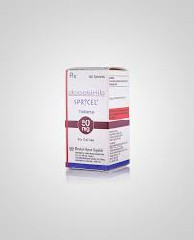
In clinical trials,Among 2440 patients treated with dasatinib at all doses, 16 patients (<1%) experienced the adverse reaction of QTc prolongation. QTcF>500ms occurred in 22 patients (1%). In five phase 2 studies, the maximum mean change from baseline in QTcF (upper limit of 90% CI) ranged from 7 ms to 13.4 ms in 865 leukemia patients treated with dasatinib 70 mg BID.
Analysis of data from five Phase 2 patient studies (70 mg BID) and one Phase 1 healthy subject study (100 mg single dose) showed that subjects receiving dasatinib treatment doses had an increase in the Fridericia-corrected QTc interval of up to 3 to 6 milliseconds from baseline, with an associated upper limit of the 95% confidence interval <10 milliseconds.
The pharmacokinetics of dasatinib showed a dose-proportional increase in the area under the plasma concentration-time curve (AUC) and linear elimination characteristics over the dose range of 15 mg/day (0.15 times the lowest approved recommended dose) to 240 mg/day (1.7 times the highest approved recommended dose).
At 100mg QD (once daily), the steady-state Cmax is 82.2 ng/mL (CV% 69%) and the AUC is 397ng/mL*hr (CV% 55%). The clearance of dasatinib was found to be unchanged over time. When administered as tablets dispersed in juice to adult healthy subjects, the adjusted geometric mean ratio for Cmax was 0.97 (90% CI: 0.85, 1.10) and for AUC was 0.84 (90% CI: 7.78, 0.91) compared to intact tablets. A high-fat meal increased the mean AUC of a single 100 mg dose of dasatinib by 14%. The total calories of high-fat food are 985 kcal. The calories from fat, carbohydrates, and protein in the high-fat meal were 52%, 34%, and 14% respectively.
[ 免责声明 ] 本页面内容来自公开渠道(如FDA官网、Drugs官网、原研药厂官网等),仅供持有医疗专业资质的人员用于医学药学研究参考,不构成任何治疗建议或药品推荐。所涉药品可能未在中国大陆获批上市,不适用于中国境内销售和使用。如需治疗,请咨询正规医疗机构。本站不提供药品销售或代购服务。


