
.jpeg)
Related clinical trials about Roprestimin/Romigrastim
A large amount of evidence supports the efficacy and safety of Romiplostim/Romiplostim in the treatment of immune thrombocytopenia (ITP) . Several clinical trials at different stages have shown that loprostimone can sustainably increase platelet counts and reduce the incidence of bleeding events in adult patients with ITP. Additionally, results from observational and real-world studies were similar to those from clinical trials; data showed that loprostim improved platelet counts and reduced bleeding events and length of stay. Interestingly, some studies report that patients remain unresponsive to treatment for considerable periods of time.
In the phase 2 trial, the median time from the first dose to peak platelet count was 18 days in the 1 μg/kg dose group, 19 days in the 3 μg/kg dose group, and 63 days in the placebo group. In a phase 3 trial that included splenectomized and non-splenectomized adult patients, 25% of patients achieved target platelet counts ≥50×109/L after taking ropruprimostat for 1 week, and 50% of patients achieved target platelet counts ≥50×109/L after taking ropruprimostat for 2-3 weeks. In another phase 3 trial, 76% of adults who received loprostim had a response (platelet count ≥50 × 109/L) at week 2.
A meta-analysis reported that 68% of splenectomized patients and 80% of non-splenectomized patients achieved sustained platelet responses (defined as platelet counts ≥50 × 109/L for 9 of 12 weeks without the use of rescue medications in the 4 weeks before each qualifying platelet count).
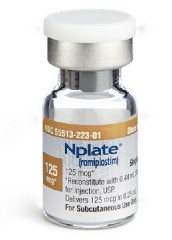
In a prospective multicenter interventional study, patients with persistent or chronic primary ITP who were refractory to TPO-RAs (roproprim or eltrombopag)Treatment of adults with complete remission,27 of 48 patients achieved sustained complete remission (platelet count>30×109/L and no bleeding) after the end of treatment, and 15 of 48 patients achieved sustained complete remission (platelet count>100×109/L, no bleeding) at week 24. Furthermore, in a multicenter observational study of 121 adult patients with ITP, 51.3% of patients who received loplastin achieved treatment-free response (platelet count ≥50 × 109/L for at least 6 months without any treatment aimed at increasing platelet count).
Integrated analysis of data from 9 studies showed that roplastin increased platelet counts in patients with ITP ≤1 year or ITP >1 year, and there were more treatment-free responses in patients with ITP ≤1 year. The safety profiles of loprostim and placebo/standard treatment were similar. The ITP Patient Assessment Questionnaire was used to investigate the impact of treatment with loproprimon on HRQoL in splenectomized and non-splenectomized patients in two placebo-controlled phase 3 clinical trials. Pooled data from these clinical trials show that ropremilast significantly improves health-related quality of life (HRQoL) in adults with chronic ITP.
Roprostim was well tolerated and showed mild to moderate adverse events (AEs) in clinical trials. Short-term AEs include headache, fatigue, arthralgia, dizziness, insomnia, myalgia, limb pain, abdominal pain, shoulder pain, dyspepsia, and paresthesia. Reported serious adverse events included bleeding, thrombosis, increased bone marrow reticulin, and blood tumors or myelodysplastic syndromes. Bleeding was considered unrelated to treatment. Although Roprostim does not increase the risk of thromboembolic complications, it should be used with caution in ITP patients with a history of thromboembolic complications or an increased risk of thromboembolic complications.
Few studies have reported that some patients developed neutralizing antibodies to loproprimastat; however, these antibodies were not associated with clinical complications or reduced platelet counts.
[ 免责声明 ] 本页面内容来自公开渠道(如FDA官网、Drugs官网、原研药厂官网等),仅供持有医疗专业资质的人员用于医学药学研究参考,不构成任何治疗建议或药品推荐。所涉药品可能未在中国大陆获批上市,不适用于中国境内销售和使用。如需治疗,请咨询正规医疗机构。本站不提供药品销售或代购服务。


