
.jpeg)
Chinese instructions for Canafenib/Encorafenib
1. Generic name: Encorafenib
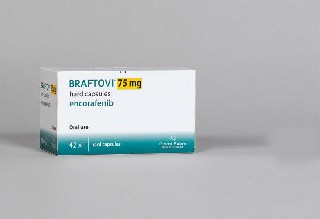
Product name: BRAFTOVI
Other names: canafenib, ennolfenib, encofenib, canafenib, etc. (transliterated name)
2. Indications:
1. Unresectable or metastatic melanoma positive for BRAF V600E or V600K mutations: Encorafenib can be used in combination with binimetinib to treat patients with unresectable or metastatic melanoma who have BRAF V600E or V600K mutations detected by FDA-approved tests.
2. BRAF V600E mutation-positive metastatic colorectal cancer (CRC): Canafenib can be used in combination with cetuximab for the treatment of adult patients with metastatic colorectal cancer whose BRAF V600E mutation has been detected by an FDA-approved test after previous treatment.
3. BRAF V600E mutation-positive metastatic non-small cell lung cancer (NSCLC): Canafenib in combination with binimetinib is indicated for the treatment of adult patients with metastatic non-small cell lung cancer whose BRAF V600E mutation has been detected in an FDA-approved test.
3. Usage and dosage:
1. Before treatment: Before starting treatment with canafenib, confirm the presence of BRAF V600E or V600K mutation in the tumor specimen; if no mutation is detected in the plasma specimen, detect the tumor tissue.
2. Recommended dosage:
(1) For patients with BRAF V600E or V600K mutation-positive unresectable or metastatic melanoma and BRAF V600E mutation-positive metastatic non-small cell lung cancer, the recommended dose of canafenib is 450 mg (six 75 mg capsules) once daily in combination with binimetinib until disease progression or unacceptable toxicity occurs.
(2) For patients with BRAF V600E mutation-positive metastatic colorectal cancer, the recommended dose of canafenib is 300 mg (four 75 mg capsules) once daily in combination with cetuximab until disease progression or unacceptable toxicity occurs.
3. Dose adjustment: Patients may experience adverse reactions when using canafenib, and doctors may adjust the drug dosage according to the severity of the condition;
(1) For melanoma and non-small cell lung cancer, the first dose of canafenib can be reduced to 300 mg (four 75 mg capsules) once daily; the second dose can be reduced to 225 mg (three 75 mg capsules) once daily; if the dose of 225 mg of canafenib is not tolerated, discontinue use permanently.
(2) For patients with colorectal cancer, the first dose of canafenib can be reduced to 225 mg (three 75 mg capsules) once a day; the second dose can be reduced to 150 mg (two 75 mg capsules) once a day; if the dose of 150 mg of canafenib is not tolerated, discontinue use permanently.
(3) Concomitant use with strong or moderate CYP3A4 inhibitors: Avoid concomitant use of canafenib with strong or moderate CYP3A4 inhibitors. If coadministration is unavoidable, resume canafenib at the same dose you took before starting the CYP3A4 inhibitor 3 to 5 elimination half-lives after discontinuation of the inhibitor.
4. Medication management: Canafenib can be taken with or without food. Do not take a missed dose of canafenib within 12 hours after your next dose of canafenib. If vomiting occurs after taking canafenib, do not take additional doses but continue with the next scheduled dose.
4. Adverse reactions:
The most common side effects of taking canafenib andbinimetinib together at the highest recommended dose include fatigue, nausea, diarrhea, vomiting, abdominal pain, muscle aches or muscle problems, and joint pain; canafenib and cetuximab The most common side effects of mAbs include fatigue, nausea, diarrhea, dermatitis acneiformis (a skin disease that causes the formation of small, raised, acne-like bumps, usually on the face, scalp, chest, and upper back), abdominal pain, joint pain, or muscle and bone pain, decreased appetite, rash, and vomiting.
5. Supply and storage:
Canafenib is supplied as 75 mg hard gelatin capsules and should be stored at 20°C to 25°C (68°F to 77°F) ; tolerances are allowed between15°C and 30°C (59°F and 86°F). Do not use if safety seal under cap is broken or missing. Use original bottles. Do not remove the desiccant. Moisture proof. Keep container tightly closed.
6. Taboo:
Canafenib is not indicated for the treatment of patients with wild-type BRAF melanoma, wild-type BRAF colorectal cancer, or wild-type BRAF non-small cell lung cancer.
7. Mechanism of action:
Canafenib is a kinase inhibitor against BRAF V600E, as well as wild-type BRAF and CRAF in in vitro cell-free assays, with IC50 values of 0.35, 0.47 and 0.3nM, respectively. Mutations in the BRAF gene, such as BRAF V600E, can lead to constitutively activated BRAF kinase, thereby stimulating tumor cell growth. Canafenib is also able to bind to other kinases in vitro, including JNK1, JNK2, JNK3, LIMK1, LIMK2, MEK4, and STK36, and reduce ligand binding to these kinases at clinically achievable concentrations (≤0.9 μM).
Canafenib inhibits the in vitro growth of tumor cell lines expressingBRAF V600 E, D, and K mutations. In mice implanted with BRAF V600E-expressing tumor cells, canafenib induced tumor regression associated with inhibition of the RAF/MEK/ERK pathway.
[ 免责声明 ] 本页面内容来自公开渠道(如FDA官网、Drugs官网、原研药厂官网等),仅供持有医疗专业资质的人员用于医学药学研究参考,不构成任何治疗建议或药品推荐。所涉药品可能未在中国大陆获批上市,不适用于中国境内销售和使用。如需治疗,请咨询正规医疗机构。本站不提供药品销售或代购服务。


