
.jpeg)
How effective is Vyloy (zolbetuximab-clzb)?
Vyloy (zolbetuximab-clzb) is indicated in combination with fluoropyrimidine- and platinum-containing chemotherapy regimens for the first-line treatment of adults with locally advanced unresectable or metastatic human epidermal growth factor receptor 2 (HER2)-negative adenocarcinoma of the stomach or gastroesophageal junction whose tumors are positive for tight junction protein 18.2 (CLDN18.2) as determined by an FDA-approved test.
Efficacy was evaluated in trialsSPOTLIGHT (NCT03504397) and GLOW (NCT03653507). Both trials were randomized (1:1), double-blind, multicenter trials, enrolling patients with CLDN18.2-positive advanced unresectable or metastatic HER2-negative gastric or GEJ adenocarcinoma. The primary efficacy outcome measure in both trials was progression-free survival (PFS), as assessed by an independent review committee according to RECIST v1.1. Overall survival (OS) was an additional efficacy outcome measure.
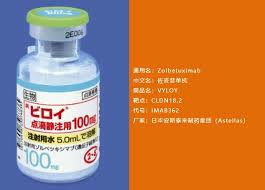
InSPOTLIGHT, 565 patients were randomized to receive either Vyloy plus mFOLFOX6 chemotherapy or placebo plus mFOLFOX6 chemotherapy. Median PFS was 10.6 months (95% confidence interval [CI]: 8.9-12.5) in the Vyloy/chemotherapy group and 8.7 months (95% CI: 8.2- 10.3) (hazard ratio [HR] 0.751; 95% CI:0.598-0.942]; one-sided p value=0.0066). The median OS were 18.2 months (95%CI: 16.4-22.9) and 15.5 months, (95%CI: 3.5-16.5) respectively (HR 0.750; 95%CI: 0.601, 0.936; one-sided p value=0.0053).
InGLOW, 507 patients were randomized to receive Vyloy plus CAPOX chemotherapy or placebo plus CAPOX chemotherapy. Median PFS was 8.2 months (95%CI: 7.5-8.8) in the Vyloy/chemotherapy group and 6.8 months (95%CI: 6.1-8.1) in the placebo/chemotherapy group (hazard ratio [HR] 0.687; 95%CI: 0.544-0.866; one-sided p-value=0.0007). The median OS were 14.4 months (95%CI: 12.3-16.5) and 12.2 months (95%CI: 10.3-13.7) respectively (HR0.771; 95%CI: 0.615-0.965; one-sided p value=0.0118).
The most common serious adverse reactions in the SPOTLIGHT trial (≥2%) are vomiting, nausea, neutropenia, febrile neutropenia, diarrhea, ileus, pyrexia, pneumonia, respiratory failure, pulmonary embolism, decreased appetite, and sepsis. The most common serious adverse reactions (≥2%) in the GLOW trial were vomiting, nausea, decreased appetite, decreased platelet count, upper gastrointestinal bleeding, diarrhea, pneumonia, pulmonary embolism, and pyrexia.
[ 免责声明 ] 本页面内容来自公开渠道(如FDA官网、Drugs官网、原研药厂官网等),仅供持有医疗专业资质的人员用于医学药学研究参考,不构成任何治疗建议或药品推荐。所涉药品可能未在中国大陆获批上市,不适用于中国境内销售和使用。如需治疗,请咨询正规医疗机构。本站不提供药品销售或代购服务。


