
.jpeg)
Instructions for Avatrombopag (Avatrombopag, Sucoxin)
1. Name: avatrombopag, Avatrombopag, Doptelet, Sucoxin, avatrombopag maleate, avatrombopag
2. Indications:
Avatrombopag/Avatrombopag is mainly used to treat the following conditions:
1. Treatment of thrombocytopenia in patients with chronic liver disease (CLD): It is suitable for the treatment of thrombocytopenia in adult patients with chronic liver disease who plan to undergo surgery.
2. Treatment of thrombocytopenia in patients with chronic immune thrombocytopenia (ITP): It is suitable for the treatment of thrombocytopenia in adult patients with chronic immune thrombocytopenia who have insufficient response to previous treatment.
3. Usage and dosage:
1. Medication management: Obtain platelet counts from patients before treatment with avatrombopag and on the day of surgery to ensure an appropriate increase in platelet counts. Assess platelet counts weekly until a stable platelet count is ≥50×10^9/L, then obtain platelet counts monthly. After discontinuing avatrombopag, obtain platelet counts weekly for at least 4 weeks. Do not use avatrombopag to normalize platelet counts.
2. Recommended dosage:
(1) Thrombocytopenia in patients with chronic liver disease (CLD): Begin administration of avatropopag 10 to 13 days before planned surgery. The recommended daily dose is based on the patient's blood count before planned surgery. For plate count, when the patient's platelet count is <40×10^9/L, take 60 mg (3 tablets) orally once a day; when the patient's platelet count is 40-50×10^9/L, take 40 mg (2 tablets) orally once a day for 5 days. Patients should have surgery 5 to 8 days after the last dose of avatropopag.
(2) Thrombocytopenia in patients with chronic immune thrombocytopenia (ITP): The starting dose of avatrombopag is 20 mg (1 tablet) once daily, taken with food. If necessary, use the lowest dose of avatrombopag required to achieve and maintain a platelet count of ≥50×10^9/L, thereby reducing the risk of bleeding. The daily dose shall not exceed 40 mg.
(3) Discontinuation:If the platelet count does not increase to ≥50×10^9/L after 4 weeks of administration, discontinue avatropopag . The maximum dose is 40 mg once daily. If the platelet count is >400×109/L after 2 weeks of 20 mg administration once a week, discontinue avatropopag.
3. Combined medication: If avatrombopag is used in combination with a moderate or severe dual inhibitor of CYP2C9 and CYP3A4, take 20 mg (1 tablet) three times a week; if it is used with a moderate or strong dual inducer of CYP2C9 and CYP3A4, take 40 mg of avatrombopag (2 tablets) once a day.
4. Adverse reactions:
In clinical studies of avatrombopag in the treatment of various types of thrombocytopenia, the most common adverse reactions were fever, abdominal pain, nausea, headache, fatigue and peripheral edema. Hyponatremia was also a rare serious side effect of the drug. After avatrombopag was launched, adverse events related to immune system diseases also occurred, including itching, rash, suffocation, erythema, pharyngeal edema, general itching, macules, facial swelling, and tongue swelling.
5. Supply and storage:
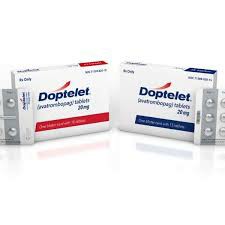
Avatrombopag tablets are available as20 mg tablets as round, biconvex, yellow film-coated tablets that are stored at 20°C to 25°C (68°F to 77°F), with excursions allowed within the temperature range of 15°C to 30°C (59°F to 86°F). Keep tablets in their original packaging.
6. Special groups:
1. Breastfeeding women: Breastfeeding women taking avatrombopag in the short term (such as before surgery) should interrupt breastfeeding during treatment and for two weeks after the last dose, and pump and discard breast milk to minimize contact with breastfed children. It is recommended that nursing women receiving long-term avatrombopag therapy not breastfeed during treatment and for at least 2 weeks after the last dose of drug.
7. Mechanism of action:
Avatrombopag is an orally bioavailable small moleculeTPO receptor agonist that stimulates the proliferation and differentiation of megakaryocytes in bone marrow progenitor cells, thereby increasing platelet production. Avatrombopag does not compete with TPO for binding to the TPO receptor and has an additive effect with TPO on platelet production.
8. Overdose:
If you take too much of avatrombopag, your platelet count may increase excessively, leading to thrombosis or thromboembolic complications. Monitor patients and platelet counts closely. Treat thrombotic complications according to standard of care. The antidote for avatrombopag overdose is currently unknown. Hemodialysis is not expected to enhance the elimination of avatropopag because only approximately 6% of avatropopag is excreted by the kidneys and is highly bound to plasma proteins.
Reference materials:https://dailymed.nlm.nih.gov/dailymed/drugInfo.cfm?setid=e2d5960d-6c18-46cc-86bd-089222b09852
[ 免责声明 ] 本页面内容来自公开渠道(如FDA官网、Drugs官网、原研药厂官网等),仅供持有医疗专业资质的人员用于医学药学研究参考,不构成任何治疗建议或药品推荐。所涉药品可能未在中国大陆获批上市,不适用于中国境内销售和使用。如需治疗,请咨询正规医疗机构。本站不提供药品销售或代购服务。


