
.jpeg)
Real-world data shows activity of ivosidenib/tosuvox in IDH1+ cholangiocarcinoma
Real-world data from the Phase 3b ProvIDHe study (NCT05876754), based on a report released in 2025 It shows that patients with cholangiocarcinoma (CCA) carrying IDH1 mutations who received Ivosidenib (Ivosidenib) have preliminary activity. Preliminary data from ProvIDHe showed that the median progression-free survival (PFS) in the full analysis set (n=262) was 4.7 months (95% CI, 3.5-5.7). The progression-free survival rates at 3 months, 6 months and 12 months were 64.2%, 40.1% and 28.2% respectively. Additionally, the median overall survival (OS) was 15.5 months (95% CI, 12.7 not evaluable [NE]). The 3-month, 6-month and 12-month OS rates were 88.3%, 80.3% and 60.0% respectively.
This interim analysis provides preliminary results from the ProvIDHe study, which [enrolled] the Phase 3b real-world population, with [median] PFS and OS reassuringly favorable, and confirms and supports the original data set from the [Phase 3] ClarIDHy study [NCT02989857]. In August 2021, the U.S. Food and Drug Administration (FDA) approved ivonib for the treatment of adult patients with previously treated, locally advanced or metastatic cholangiocarcinoma who have IDH1 mutations detected by an FDA-approved test. The regulatory decision was supported by data from ClarIDHy, which showed that avosidenib reduced the risk of death or disease progression by 63% compared with placebo (HR, 0.37; 95% CI, 0.25-0.54; P0.0001).
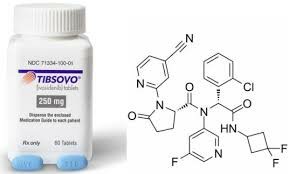
ProvIDHe is an open-label, international, early access study of ivonib in adult patients with locally advanced or metastatic IDH1-mutant cholangiocarcinoma who have received at least 1 prior therapy. Patients also required an ECOG performance status of 0 or 1; a QTcF interval of less than 450 milliseconds; and adequate bone marrow, liver, and kidney function.
Patients received 500 mg of ivotinib orally once daily during a 28-day treatment cycle. Treatment was continued until unacceptable toxicity occurred or ivosidenib was available by prescription. The study is inA total of 285 patients were enrolled at 80 sites in 15 countries. Primary outcomes included safety, number of grade 2 or worse QT prolongation events during ECG, change in ECOG performance status, change in laboratory values, and vital sign outcomes. Secondary outcomes included PFS, OS, duration of response (DOR), response time, and quality of life measures.
At baseline, the median age was 62.0 years (range, 31-90 years). Most patients were female (56.9%), had an ECOG performance status of 1 (51.9%), had a primary intrahepatic cholangiocarcinoma (89.7%), and had advanced or metastatic disease (74.8%). The median number of prior lines of therapy for advanced or metastatic disease was 2 (; patients had received 1 (39.3%), 2 (27.1%), or 2 or more (22.9%) prior lines of therapy. Prior therapy included gemcitabine monotherapy (8.4%), FOLFIRI (5-fluorouracil, leucovorin and irinotecan; 10.3%), Follfox (leucovorin, fluorouracil, and oxaliplatin; 17.6%), cisplatin-gemcitabine combination immunotherapy (42%), cisplatin/gemcitabine (40.1%), and other regimens (18.7%).
Other research results from ProvIDHe showed that according to RECIST 1.1 standards, the ORR was 5.7% (95% CI, 3.2%-9.3%); the patient's stable disease rate was 45.8%, and the disease progression rate was 23.7%. The median DOR was 10.1 months (95% CI, 3.0-NE), and the disease control rate was 51.5%.
Reference: https://www.cancernetwork.com/view/real-world-data-show-activity-with-ivosidenib-in-idh1-cholangiocarcinoma
[ 免责声明 ] 本页面内容来自公开渠道(如FDA官网、Drugs官网、原研药厂官网等),仅供持有医疗专业资质的人员用于医学药学研究参考,不构成任何治疗建议或药品推荐。所涉药品可能未在中国大陆获批上市,不适用于中国境内销售和使用。如需治疗,请咨询正规医疗机构。本站不提供药品销售或代购服务。


