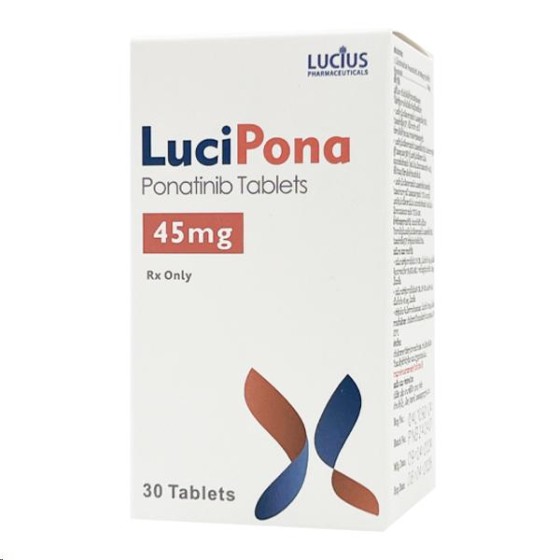
.jpeg)
Ponatinib in Chronic Myeloid Leukemia: 5-Year Results from the OPTIC Trial
From PACE to OPTIC:Why the Dose Schedule Was Redesigned
Ponatinib(Iclusig)is a third-generation BCR::ABL1 tyrosine kinase inhibitor(TKI)with potent activity against both native and mutant forms of BCR::ABL1,including T315I.Early studies using a fixed dose of 45 mg once daily showed that ponatinib was among the most active BCR::ABL1 TKIs,but that this dose also carried substantial toxicity,particularly arterial occlusive events(AOEs).The phase 2 OPTIC trial(NCT02467270)was designed to address this problem and to test whether a safer schedule could preserve efficacy.
Design and Dosing Strategy
This open-label,randomized phase 2 trial enrolled 283 patients with chronic-phase chronic myeloid leukemia(CP-CML),randomized 1:1:1 to ponatinib starting doses of 45 mg(n=94),30 mg(n=95),or 15 mg(n=94)once daily.Eligible patients were aged≥18 years,had disease resistant to at least two TKIs or a BCR::ABL1 T315I mutation,an ECOG performance status of≤2,adequate renal and hepatic function,and normal pancreatic status.Patients were excluded if they had received prior ponatinib,any approved TKI,investigational agent,interferon,cytarabine or immunotherapy within 2 weeks before the first dose,or an autologous or allogeneic stem cell transplant within 60 days.
Baseline characteristics were broadly balanced:median age was 46,51,and 49 years across the cohorts,and baseline BCR::ABL1 mutations were present in 44%,37%,and 42%of patients.
The key feature was response-based dose reduction:in the 45-mg and 30-mg cohorts,the dose was reduced to 15 mg once daily after BCR::ABL1IS≤1%(MR2)was achieved.Further reduction to 10 mg was permitted for adverse events,and dose re-escalation was allowed if MR2 was lost on two consecutive assessments.Median follow-up was 75–78 months.
Long-Term Efficacy:Response and Survival
By 5 years,60%,41%,and 40%of patients in the 45-mg,30-mg,and 15-mg cohorts,respectively,had achieved MR2,with median times to response of 6.0,3.1,and 6.2 months.Among responders,the response was maintained at 5 years in 68.8%,74.4%,and 84.3%of patients.
Five-year progression-free survival(PFS)rates were 63.1%,57%,and 60.1%;median PFS was 75 months in the 30-mg cohort and not reached in the other two.Five-year overall survival(OS)rates were 85.1%,83.3%,and 86.4%,with median OS not reached in any cohort.
Differences by Mutation Subgroup
Among patients with a baseline T315I mutation,the MR2 rate was clearly highest in the 45-mg cohort(64%,versus 25%with 30 mg and 16%with 15 mg).Five-year OS was 86.3%with 45 mg and 61.7%with 30 mg,and was lowest in the 15-mg cohort.By contrast,among patients with mutations other than T315I,MR2 rates were 56%,40%,and 50%,and five-year OS rates were 79.8%,92.3%,and 81.6%—differences that were far less pronounced.
These findings suggest that patients with T315I benefit most from starting at 45 mg followed by dose reduction,whereas those with other mutations or no mutation can start at 30 mg and reduce to 15 mg with equally satisfactory long-term survival.
Safety:The Core Value of Dose Optimization
Any-grade treatment-emergent adverse events(TEAEs)occurred in 100%of the 45-mg cohort and 97.9%of both the 30-mg and 15-mg cohorts.Grade 3 or 4 TEAEs occurred in 70.2%,66.0%,and 68.1%;serious TEAEs in 40.4%,35.1%,and 41.5%;and TEAE-related discontinuation in 24.5%,19.1%,and 20.2%.The most common any-grade hematologic TEAE was thrombocytopenia(43.6%,38.3%,38.3%),and the most common non-hematologic TEAE was hypertension(33%,41.5%,29.8%).
Exposure-adjusted rates of adjudicated arterial occlusive events were 4.1,3.8,and 2.0 per 100 patient-years,respectively—substantially lower than with the previous fixed 45-mg schedule,with similar reductions in venous occlusive events,hypertension,and rash.
Conclusions
The 5-year OPTIC data support a"start high,reduce on response"ponatinib strategy in third-line CP-CML.With an optimized dose schedule,ponatinib offers both durable long-term efficacy and improved safety,and should be considered for patients who have failed second-generation TKIs,particularly those with resistant disease or the T315I mutation.
[ 免责声明 ] 本页面内容来自公开渠道(如FDA官网、Drugs官网、原研药厂官网等),仅供持有医疗专业资质的人员用于医学药学研究参考,不构成任何治疗建议或药品推荐。所涉药品可能未在中国大陆获批上市,不适用于中国境内销售和使用。如需治疗,请咨询正规医疗机构。本站不提供药品销售或代购服务。