.jpeg)
SCEMBLIX (Asciminib) Side Effect Management & Special Population Guide
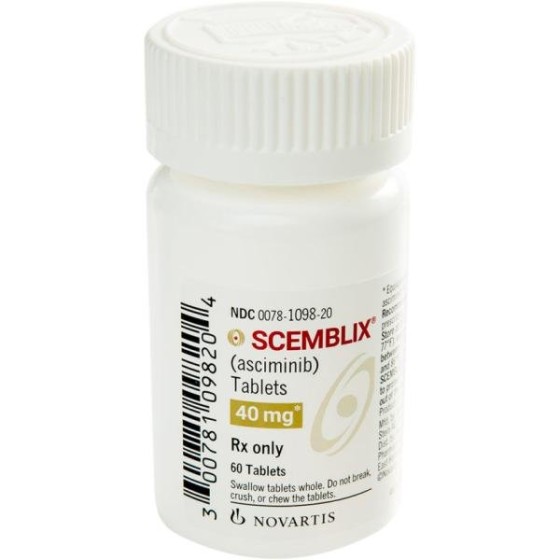
Asciminib,marketed as SCEMBLIX,is the first-in-class allosteric inhibitor targeting the BCR-ABL1 myristoyl pocket(STAMP),representing a new paradigm in the precision treatment of chronic myeloid leukemia(CML).Compared with conventional tyrosine kinase inhibitors(TKIs),asciminib offers differentiated efficacy and safety advantages;however,careful attention to its adverse effect profile and risk management in special populations remains essential in clinical practice.
1.Common Side Effects and Recognition
The most frequently reported adverse reactions with asciminib(incidence≥20%)predominantly involve the hematologic and gastrointestinal systems.Hematologic toxicities—including thrombocytopenia,neutropenia,and anemia—are the most commonly observed abnormalities and the leading cause of dose adjustments or treatment interruptions.Gastrointestinal symptoms such as nausea,diarrhea,abdominal pain,and vomiting are also common but are generally mild to moderate in severity and tend to improve over time.Fatigue,arthralgia,headache,and myalgia occur at notable frequencies as well.
Importantly,compared with first-and second-generation TKIs,asciminib carries a significantly lower risk of fluid retention(peripheral edema,pericardial effusion)and vascular occlusive events,constituting a key safety advantage.Regular complete blood count monitoring during follow-up is recommended to detect hematologic toxicity early.
2.Risk Management in Elderly Patients
CML patients aged 65 years and older face additional risks when receiving asciminib.Due to age-related decline in bone marrow reserve,elderly patients are more susceptible to thrombocytopenia and neutropenia,with slower recovery times.It is advisable to increase complete blood count monitoring frequency to at least weekly during the initial treatment phase.
Elderly patients often have varying degrees of renal impairment.Although asciminib is primarily metabolized via hepatobiliary pathways and renal function has limited impact on its pharmacokinetics,overall organ function status should still be monitored.In the event of infection signs or bleeding,more aggressive supportive measures including anti-infectives or transfusion should be promptly implemented.
3.Dose Considerations in Hepatic Impairment
Asciminib is predominantly metabolized by the hepatic CYP3A4 enzyme system.Available data indicate that no dose adjustment is required for patients with mild hepatic impairment(Child-Pugh A).However,safety and efficacy data in moderate to severe hepatic impairment(Child-Pugh B/C)are limited.Reduced drug clearance in these patients may lead to increased exposure,potentially exacerbating hepatotoxicity or myelosuppression.Caution is warranted,with close monitoring of transaminases,bilirubin,and coagulation parameters under specialist supervision.
4.Considerations in Renal Impairment
Since renal excretion of asciminib and its metabolites is minimal,no starting dose adjustment is typically needed for mild to moderate renal impairment.However,pharmacokinetic data are insufficient for patients with end-stage renal disease or those on dialysis.Such patients require heightened vigilance for fluid retention and electrolyte imbalances and should be managed under close supervision by an experienced hematologist.Renal function monitoring should be intensified in patients concurrently receiving nephrotoxic agents.
5.Cardiovascular Safety and Monitoring
Although asciminib's cardiovascular safety profile is generally favorable compared with certain second-generation TKIs,vigilance remains warranted.Blood pressure elevations or fluctuations may occur during treatment;patients should monitor blood pressure regularly and maintain a healthy lifestyle.For those with pre-existing cardiovascular disease(coronary artery disease,heart failure)or multiple cardiovascular risk factors(diabetes,hyperlipidemia),a baseline cardiac assessment is recommended before initiating therapy,with periodic ECG and echocardiographic follow-up during treatment.
6.Drug Interaction Management
Asciminib is a CYP3A4 substrate,which defines the core principles of its interaction management.Co-administration with strong CYP3A4 inhibitors(e.g.,clarithromycin,itraconazole)may significantly elevate asciminib plasma concentrations,increasing adverse event risk;dose reduction or avoidance of the combination is generally advised.Conversely,strong CYP3A4 inducers(e.g.,rifampin)reduce asciminib exposure and efficacy and should be avoided.Additionally,asciminib may increase exposure to certain CYP3A4 substrate drugs such as statins;attention to statin-related myopathy risk is warranted during co-administration.
7.Pediatric and Adolescent Patients
The safety and efficacy of asciminib in CML patients under 18 years of age have not been fully established due to insufficient clinical data.Therefore,use in pediatric patients is not currently recommended.Any consideration of enrolling pediatric CML patients in clinical trials or special treatment programs must occur within a framework of rigorous ethical review and medical oversight.
8.Fertility and Pregnancy Risk
Based on its mechanism of action and animal reproductive toxicology findings,asciminib may cause fetal harm.Women of childbearing potential must use effective contraception during treatment and for at least 14 days after the last dose.If pregnancy is confirmed during treatment,the treating physician should be contacted immediately to assess potential fetal drug exposure risk.It is unknown whether asciminib is excreted in human milk;however,given the potential risk to infants,breastfeeding should be discontinued during treatment and for two weeks after the final dose.
Summary
Asciminib(SCEMBLIX),as a BCR-ABL1 allosteric inhibitor,demonstrates favorable efficacy and safety characteristics in CML management.In clinical practice,physicians should tailor monitoring and management plans based on patient age,hepatic and renal function,comorbidities,and concomitant medications to maximize therapeutic benefit while minimizing adverse event risk.
[ 免责声明 ] 本页面内容来自公开渠道(如FDA官网、Drugs官网、原研药厂官网等),仅供持有医疗专业资质的人员用于医学药学研究参考,不构成任何治疗建议或药品推荐。所涉药品可能未在中国大陆获批上市,不适用于中国境内销售和使用。如需治疗,请咨询正规医疗机构。本站不提供药品销售或代购服务。